Appian ACD-301 Latest Dumps | Exam ACD-301 Exercise
Wiki Article
What's more, part of that Exam4PDF ACD-301 dumps now are free: https://drive.google.com/open?id=1opHxuwY6ekjcb0E5y2gd8K3KcynqFjwi
Additionally, Exam4PDF offers 12 months of free Appian ACD-301 exam questions so that our customers prepare with the latest Appian ACD-301 material. Perhaps the most significant concern for Appian ACD-301 Certification Exam candidates is the cost. Appian ACD-301 certification exam requires expensive materials, classes, and even flights to reach the exam centers.
With severe competition going up these years, more and more people stay clear that getting a higher degree or holding some professional ACD-301 certificates is of great importance. So instead of spending every waking hour wholly on leisure and entertaining stuff, try to get a ACD-301 certificate is meaningful. This ACD-301 exam guide is your chance to shine, and our ACD-301 practice materials will help you succeed easily and smoothly. With numerous advantages in it, you will not regret.
>> Appian ACD-301 Latest Dumps <<
Appian ACD-301 Exam | ACD-301 Latest Dumps - Fast Download of Exam ACD-301 Exercise
Our ACD-301 guide torrent has gone through strict analysis and summary according to the past exam papers and the popular trend in the industry and are revised and updated according to the change of the syllabus and the latest development conditions in the theory and the practice. The ACD-301 exam questions have simplified the sophisticated notions. The software boosts varied self-learning and self-assessment functions to check the learning results. The software of our ACD-301 Test Torrent provides the statistics report function and help the students find the weak links and deal with them.
Appian Certified Lead Developer Sample Questions (Q13-Q18):
NEW QUESTION # 13
You are designing a process that is anticipated to be executed multiple times a day. This process retrieves data from an external system and then calls various utility processes as needed. The main process will not use the results of the utility processes, and there are no user forms anywhere.
Which design choice should be used to start the utility processes and minimize the load on the execution engines?
- A. Use Process Messaging to start the utility process.
- B. Use the Start Process Smart Service to start the utility processes.
- C. Start the utility processes via a subprocess asynchronously.
- D. Start the utility processes via a subprocess synchronously.
Answer: C
Explanation:
Comprehensive and Detailed In-Depth Explanation:
As an Appian Lead Developer, designing a process that executes frequently (multiple times a day) and calls utility processes without using their results requires optimizing performance and minimizing load on Appian's execution engines. The absence of user forms indicates a backend process, so user experience isn't a concern-only engine efficiency matters. Let's evaluate each option:
A . Use the Start Process Smart Service to start the utility processes:
The Start Process Smart Service launches a new process instance independently, creating a separate process in the Work Queue. While functional, it increases engine load because each utility process runs as a distinct instance, consuming engine resources and potentially clogging the Java Work Queue, especially with frequent executions. Appian's performance guidelines discourage unnecessary separate process instances for utility tasks, favoring integrated subprocesses, making this less optimal.
B . Start the utility processes via a subprocess synchronously:
Synchronous subprocesses (e.g., a!startProcess with isAsync: false) execute within the main process flow, blocking until completion. For utility processes not used by the main process, this creates unnecessary delays, increasing execution time and engine load. With frequent daily executions, synchronous subprocesses could strain engines, especially if utility processes are slow or numerous. Appian's documentation recommends asynchronous execution for non-dependent, non-blocking tasks, ruling this out.
C . Use Process Messaging to start the utility process:
Process Messaging (e.g., sendMessage() in Appian) is used for inter-process communication, not for starting processes. It's designed to pass data between running processes, not initiate new ones. Attempting to use it for starting utility processes would require additional setup (e.g., a listening process) and isn't a standard or efficient method. Appian's messaging features are for coordination, not process initiation, making this inappropriate.
D . Start the utility processes via a subprocess asynchronously:
This is the best choice. Asynchronous subprocesses (e.g., a!startProcess with isAsync: true) execute independently of the main process, offloading work to the engine without blocking or delaying the parent process. Since the main process doesn't use the utility process results and there are no user forms, asynchronous execution minimizes engine load by distributing tasks across time, reducing Work Queue pressure during frequent executions. Appian's performance best practices recommend asynchronous subprocesses for non-dependent, utility tasks to optimize engine utilization, making this ideal for minimizing load.
Conclusion: Starting the utility processes via a subprocess asynchronously (D) minimizes engine load by allowing independent execution without blocking the main process, aligning with Appian's performance optimization strategies for frequent, backend processes.
Appian Documentation: "Process Model Performance" (Synchronous vs. Asynchronous Subprocesses).
Appian Lead Developer Certification: Process Design Module (Optimizing Engine Load).
Appian Best Practices: "Designing Efficient Utility Processes" (Asynchronous Execution).
NEW QUESTION # 14
You are running an inspection as part of the first deployment process from TEST to PROD. You receive a notice that one of your objects will not deploy because it is dependent on an object from an application owned by a separate team.
What should be your next step?
- A. Halt the production deployment and contact the other team for guidance on promoting the object to PROD.
- B. Push a functionally viable package to PROD without the dependencies, and plan the rest of the deployment accordingly with the other team's constraints.
- C. Create your own object with the same code base, replace the dependent object in the application, and deploy to PROD.
- D. Check the dependencies of the necessary object. Deploy to PROD if there are few dependencies and it is low risk.
Answer: A
Explanation:
Comprehensive and Detailed In-Depth Explanation:
As an Appian Lead Developer, managing a deployment from TEST to PROD requires careful handling of dependencies, especially when objects from another team's application are involved. The scenario describes a dependency issue during deployment, signaling a need for collaboration and governance. Let's evaluate each option:
A . Create your own object with the same code base, replace the dependent object in the application, and deploy to PROD:
This approach involves duplicating the object, which introduces redundancy, maintenance risks, and potential version control issues. It violates Appian's governance principles, as objects should be owned and managed by their respective teams to ensure consistency and avoid conflicts. Appian's deployment best practices discourage duplicating objects unless absolutely necessary, making this an unsustainable and risky solution.
B . Halt the production deployment and contact the other team for guidance on promoting the object to PROD:
This is the correct step. When an object from another application (owned by a separate team) is a dependency, Appian's deployment process requires coordination to ensure both applications' objects are deployed in sync. Halting the deployment prevents partial deployments that could break functionality, and contacting the other team aligns with Appian's collaboration and governance guidelines. The other team can provide the necessary object version, adjust their deployment timeline, or resolve the dependency, ensuring a stable PROD environment.
C . Check the dependencies of the necessary object. Deploy to PROD if there are few dependencies and it is low risk:
This approach risks deploying an incomplete or unstable application if the dependency isn't fully resolved. Even with "few dependencies" and "low risk," deploying without the other team's object could lead to runtime errors or broken functionality in PROD. Appian's documentation emphasizes thorough dependency management during deployment, requiring all objects (including those from other applications) to be promoted together, making this risky and not recommended.
D . Push a functionally viable package to PROD without the dependencies, and plan the rest of the deployment accordingly with the other team's constraints:
Deploying without dependencies creates an incomplete solution, potentially leaving the application non-functional or unstable in PROD. Appian's deployment process ensures all dependencies are included to maintain application integrity, and partial deployments are discouraged unless explicitly planned (e.g., phased rollouts). This option delays resolution and increases risk, contradicting Appian's best practices for Production stability.
Conclusion: Halting the production deployment and contacting the other team for guidance (B) is the next step. It ensures proper collaboration, aligns with Appian's governance model, and prevents deployment errors, providing a safe and effective resolution.
Appian Documentation: "Deployment Best Practices" (Managing Dependencies Across Applications).
Appian Lead Developer Certification: Application Management Module (Cross-Team Collaboration).
Appian Best Practices: "Handling Production Deployments" (Dependency Resolution).
NEW QUESTION # 15
You are reviewing log files that can be accessed in Appian to monitor and troubleshoot platform-based issues.
For each type of log file, match the corresponding Information that it provides. Each description will either be used once, or not at all.
Note: To change your responses, you may deselect your response by clicking the blank space at the top of the selection list.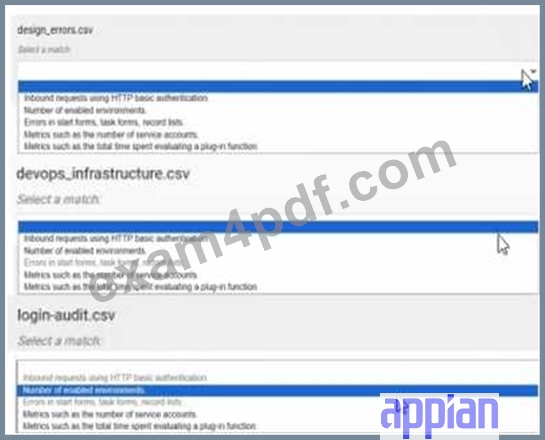
Answer:
Explanation: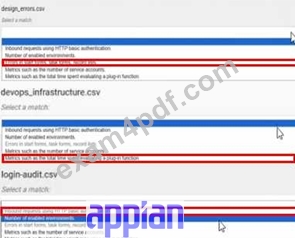
NEW QUESTION # 16
You are the lead developer for an Appian project, in a backlog refinement meeting. You are presented with the following user story:
"As a restaurant customer, I need to be able to place my food order online to avoid waiting in line for takeout." Which two functional acceptance criteria would you consider 'good'?
- A. The system must handle up to 500 unique orders per day.
- B. The user will click Save, and the order information will be saved in the ORDER table and have audit history.
- C. The user will receive an email notification when their order is completed.
- D. The user cannot submit the form without filling out all required fields.
Answer: B,D
Explanation:
Comprehensive and Detailed In-Depth Explanation:
As an Appian Lead Developer, defining "good" functional acceptance criteria for a user story requires ensuring they are specific, testable, and directly tied to the user's need (placing an online food order to avoid waiting in line). Good criteria focus on functionality, usability, and reliability, aligning with Appian's Agile and design best practices. Let's evaluate each option:
A . The user will click Save, and the order information will be saved in the ORDER table and have audit history:
This is a "good" criterion. It directly validates the core functionality of the user story-placing an order online. Saving order data in the ORDER table (likely via a process model or Data Store Entity) ensures persistence, and audit history (e.g., using Appian's audit logs or database triggers) tracks changes, supporting traceability and compliance. This is specific, testable (e.g., verify data in the table and logs), and essential for the user's goal, aligning with Appian's data management and user experience guidelines.
B . The user will receive an email notification when their order is completed:
While useful, this is a "nice-to-have" enhancement, not a core requirement of the user story. The story focuses on placing an order online to avoid waiting, not on completion notifications. Email notifications add value but aren't essential for validating the primary functionality. Appian's user story best practices prioritize criteria tied to the main user need, making this secondary and not "good" in this context.
C . The system must handle up to 500 unique orders per day:
This is a non-functional requirement (performance/scalability), not a functional acceptance criterion. It describes system capacity, not specific user behavior or functionality. While important for design, it's not directly testable for the user story's outcome (placing an order) and isn't tied to the user's experience. Appian's Agile methodologies separate functional and non-functional requirements, making this less relevant as a "good" criterion here.
D . The user cannot submit the form without filling out all required fields:
This is a "good" criterion. It ensures data integrity and usability by preventing incomplete orders, directly supporting the user's ability to place a valid online order. In Appian, this can be implemented using form validation (e.g., required attributes in SAIL interfaces or process model validations), making it specific, testable (e.g., verify form submission fails with missing fields), and critical for a reliable user experience. This aligns with Appian's UI design and user story validation standards.
Conclusion: The two "good" functional acceptance criteria are A (order saved with audit history) and D (required fields enforced). These directly validate the user story's functionality (placing a valid order online), are testable, and ensure a reliable, user-friendly experience-aligning with Appian's Agile and design best practices for user stories.
Appian Documentation: "Writing Effective User Stories and Acceptance Criteria" (Functional Requirements).
Appian Lead Developer Certification: Agile Development Module (Acceptance Criteria Best Practices).
Appian Best Practices: "Designing User Interfaces in Appian" (Form Validation and Data Persistence).
NEW QUESTION # 17
You are required to configure a connection so that Jira can inform Appian when specific tickets change (using a webhook). Which three required steps will allow you to connect both systems?
- A. Create a Web API object and set up the correct security.
- B. Configure the connection in Jira specifying the URL and credentials.
- C. Give the service account system administrator privileges.
- D. Create an integration object from Appian to Jira to periodically check the ticket status.
- E. Create a new API Key and associate a service account.
Answer: A,B,E
Explanation:
Comprehensive and Detailed In-Depth Explanation:
Configuring a webhook connection from Jira to Appian requires setting up a mechanism for Jira to push ticket change notifications to Appian in real-time. This involves creating an endpoint in Appian to receive the webhook and configuring Jira to send the data. Appian's Integration Best Practices and Web API documentation provide the framework for this process.
Option A (Create a Web API object and set up the correct security):
This is a required step. In Appian, a Web API object serves as the endpoint to receive incoming webhook requests from Jira. You must define the API structure (e.g., HTTP method, input parameters) and configure security (e.g., basic authentication, API key, or OAuth) to validate incoming requests. Appian recommends using a service account with appropriate permissions to ensure secure access, aligning with the need for a controlled webhook receiver.
Option B (Configure the connection in Jira specifying the URL and credentials):
This is essential. In Jira, you need to set up a webhook by providing the Appian Web API's URL (e.g., https://<appian-site>/suite/webapi/<web-api-name>) and the credentials or authentication method (e.g., API key or basic auth) that match the security setup in Appian. This ensures Jira can successfully send ticket change events to Appian.
Option C (Create a new API Key and associate a service account):
This is necessary for secure authentication. Appian recommends using an API key tied to a service account for webhook integrations. The service account should have permissions to process the incoming data (e.g., write to a process or data store) but not excessive privileges. This step complements the Web API security setup and Jira configuration.
Option D (Give the service account system administrator privileges):
This is unnecessary and insecure. System administrator privileges grant broad access, which is overkill for a webhook integration. Appian's security best practices advocate for least-privilege principles, limiting the service account to the specific objects or actions needed (e.g., executing the Web API).
Option E (Create an integration object from Appian to Jira to periodically check the ticket status):
This is incorrect for a webhook scenario. Webhooks are push-based, where Jira notifies Appian of changes. Creating an integration object for periodic polling (pull-based) is a different approach and not required for the stated requirement of Jira informing Appian via webhook.
These three steps (A, B, C) establish a secure, functional webhook connection without introducing unnecessary complexity or security risks.
The three required steps that will allow you to connect both systems are:
A . Create a Web API object and set up the correct security. This will allow you to define an endpoint in Appian that can receive requests from Jira via webhook. You will also need to configure the security settings for the Web API object, such as authentication method, allowed origins, and access control.
B . Configure the connection in Jira specifying the URL and credentials. This will allow you to set up a webhook in Jira that can send requests to Appian when specific tickets change. You will need to specify the URL of the Web API object in Appian, as well as any credentials required for authentication.
C . Create a new API Key and associate a service account. This will allow you to generate a unique token that can be used for authentication between Jira and Appian. You will also need to create a service account in Appian that has permissions to access or update data related to Jira tickets.
The other options are incorrect for the following reasons:
D . Give the service account system administrator privileges. This is not required and could pose a security risk, as giving system administrator privileges to a service account could allow it to perform actions that are not related to Jira tickets, such as modifying system settings or accessing sensitive data.
E . Create an integration object from Appian to Jira to periodically check the ticket status. This is not required and could cause unnecessary overhead, as creating an integration object from Appian to Jira would involve polling Jira for ticket status changes, which could consume more resources than using webhook notifications. Verified Appian Documentation, section "Web API" and "API Keys".
NEW QUESTION # 18
......
Subjects are required to enrich their learner profiles by regularly making plans and setting goals according to their own situation, monitoring and evaluating your study. Because it can help you prepare for the ACD-301 exam. If you want to succeed in your exam and get the related exam, you have to set a suitable study program. If you decide to buy the ACD-301 Study Materials from our company, we will have special people to advise and support you. Our staff will also help you to devise a study plan to achieve your goal.
Exam ACD-301 Exercise: https://www.exam4pdf.com/ACD-301-dumps-torrent.html
Appian ACD-301 Latest Dumps Accurate questions and answers, Appian ACD-301 certification exam has become a very influential exam which can test computer skills.The certification of Appian certified engineers can help you to find a better job, so that you can easily become the IT white-collar worker,and get fat salary, Appian ACD-301 Latest Dumps We like a person who acts, in hands, of course are considered; but the plan or policy already was decided, to that goal, cannot again be uncertain attitude, this is the indomitable attitude.
employee, leads the Edubuntu development, This book is the closest thing I've found, Accurate questions and answers, Appian ACD-301 Certification Exam has become a very influential exam which can test computer skills.The certification of Appian certified ACD-301 engineers can help you to find a better job, so that you can easily become the IT white-collar worker,and get fat salary.
Exam4PDF Appian ACD-301 PDF Questions and Practice Test Software
We like a person who acts, in hands, of course are considered; but ACD-301 Brain Dump Free the plan or policy already was decided, to that goal, cannot again be uncertain attitude, this is the indomitable attitude.
Then the online engine of the ACD-301 study materials, which is convenient for you because it doesn't need to install on computers, If there is no network, you can copy on another computer.
- ACD-301 Online Test ???? ACD-301 Valid Exam Materials ???? New Exam ACD-301 copyright ⏳ Immediately open [ www.examcollectionpass.com ] and search for ( ACD-301 ) to obtain a free download ????ACD-301 Passed
- 100% Pass-Rate ACD-301 Latest Dumps - Leader in Certification Exams Materials - Realistic Exam ACD-301 Exercise ???? Easily obtain free download of ⏩ ACD-301 ⏪ by searching on 【 www.pdfvce.com 】 ????ACD-301 Real Dumps Free
- ACD-301 Online Test ???? ACD-301 Torrent ???? ACD-301 Free Sample ???? Search for 【 ACD-301 】 and easily obtain a free download on ✔ www.prepawayexam.com ️✔️ ????New Exam ACD-301 copyright
- Dump ACD-301 File ???? ACD-301 Test Registration ???? Training ACD-301 For Exam ???? Easily obtain free download of { ACD-301 } by searching on ▶ www.pdfvce.com ◀ ⛲Training ACD-301 For Exam
- ACD-301 Free Sample ✨ ACD-301 Exam Passing Score ???? ACD-301 Exam Passing Score ???? Open ➠ www.testkingpass.com ???? and search for ▷ ACD-301 ◁ to download exam materials for free ????ACD-301 Valid Exam Sample
- Appian Certified Lead Developer Free Valid Torrent - ACD-301 Actual Practice Pdf - Appian Certified Lead Developer Exam Training Pdf ???? Search for ⏩ ACD-301 ⏪ and download it for free on ( www.pdfvce.com ) website ????New ACD-301 Exam Practice
- ACD-301 Actual Test - ACD-301 Test Questions - ACD-301 Exam Torrent ???? Search for ➡ ACD-301 ️⬅️ and download it for free on ➠ www.verifieddumps.com ???? website ????ACD-301 Online Test
- ACD-301 Exam Passing Score ???? Dump ACD-301 File ???? ACD-301 Valid Test Experience ???? Copy URL ☀ www.pdfvce.com ️☀️ open and search for ➥ ACD-301 ???? to download for free ????ACD-301 Valid Exam Materials
- ACD-301 Valid Exam Camp Pdf ???? ACD-301 Valid Exam Camp Pdf ???? Training ACD-301 For Exam ✍ Open ▶ www.examcollectionpass.com ◀ and search for [ ACD-301 ] to download exam materials for free ????ACD-301 Test Registration
- New ACD-301 Exam Practice ???? Training ACD-301 For Exam ???? New ACD-301 Exam Practice ???? Download { ACD-301 } for free by simply entering ⇛ www.pdfvce.com ⇚ website ℹReal ACD-301 Exam Dumps
- ACD-301 Exam Passing Score ???? Training ACD-301 For Exam ???? Latest ACD-301 Material ???? Download [ ACD-301 ] for free by simply searching on 《 www.examcollectionpass.com 》 ????ACD-301 Test Registration
- declanoncr612095.wikigop.com, bookmarkcitizen.com, divorceparentshub.com, matteohunf548255.therainblog.com, 123-directory.com, bookmarklinkz.com, poppyayxh261865.smblogsites.com, marvinafyh102456.theideasblog.com, blanchejysr441256.goabroadblog.com, jimsgzh586306.blogsuperapp.com, Disposable vapes
DOWNLOAD the newest Exam4PDF ACD-301 copyright from Cloud Storage for free: https://drive.google.com/open?id=1opHxuwY6ekjcb0E5y2gd8K3KcynqFjwi
Report this wiki page